Get Yacht Clubs Manager running at your club. Book a 20-minute walkthrough.
Most club websites were built once, by a volunteer, and have been slowly going out of date ever since. The home page still advertises last season's open meeting, the results link is broken, and members have learned that the real information is in a WhatsApp group. If you want a yacht club website members use, the design matters less than one simple thing: there has to be a reason to come back, and the committee has to be able to keep it current without a developer.
This post looks at what brings members back, what the site needs to do for visitors, and how to keep it fresh through the season.
Reasons for members to come back
Members return to a site when it is the quickest way to get something they need. On a club website, that means a handful of things done well rather than dozens of pages.
News with photos
Race reports, AGM notices, cadet training weekends, working parties: short stories with a good photo are what members look for first. In Yacht Clubs Manager, news stories have categories (race, social, announcements and so on), photos, and can link to the related event or sponsor. Visitors can search and filter by category, so last year's regatta report is still easy to find. Stories can also be pulled straight into the club newsletter, so writing one piece of news does two jobs.
Events people can actually enter
An events calendar is only useful if it answers "when, where, and how do I enter?". Each event page can carry its documents, such as the Notice of Race and Sailing Instructions, and, where the club turns on registration, an entry form with online payment. When members know entries happen on the website, they check the website. The events secretary's guide walks through this.
Results in one place
Sailors want their results. A Results page that collects links to your published results and uploaded PDFs means nobody has to hunt through emails after a series.
A members area that tells people what's new
The public site brings people in; the members area is where they get things done. Once logged in, a member lands on a dashboard of cards: documents, the noticeboard, their duty roster, the forum, their invoices, crew finder and bookings, depending on what your club has switched on.
The detail that makes the difference is the "new since your last visit" badges. A member can see at a glance that there are two new notices, a new document, a new forum post, or a swap request on one of their duties. Unpaid invoices are flagged too, with overdue ones highlighted. That turns the members area from somewhere you go when you have to into somewhere worth checking.
- The noticeboard is for official club notices and members' own posts (boats for sale, lost property, working parties). Members can submit posts, which the committee moderates before they appear.
- Documents such as bye-laws, minutes and safety policies are organised by category, so members stop asking for the "latest version".
- Invoices, duties and bookings sit with the member's own record, so the answer to "what do I owe?" or "when's my duty?" is always there.
What your club website needs to do for visitors
Prospective members, visiting sailors and parents looking at junior sailing all arrive with a question. The site should answer it and give them a next step.
A proper route to membership
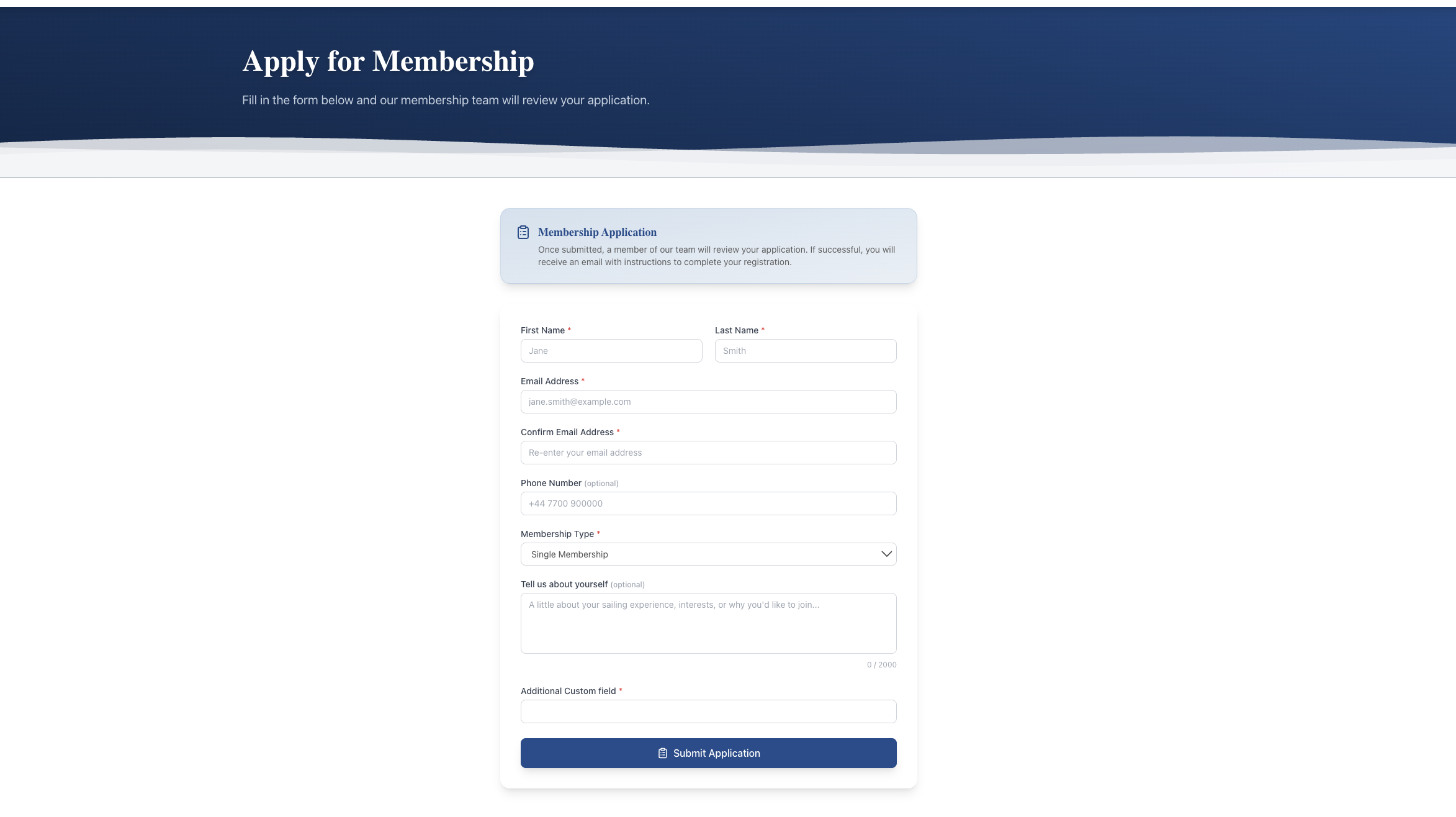
Joining a club is rarely instant, and the website shouldn't pretend otherwise. The public application form is designed by the club: the built-in fields, proposer and seconder if you use them, your own custom questions (including file uploads), and the membership types from your own list. When someone applies, the committee is emailed. The committee accepts or declines. If accepted, the applicant receives an invitation email with a link, valid for seven days, to a step-by-step sign-up where they add their details, family, emergency contacts, qualifications and boats and set a password. The member side of this is covered in joining your sailing club online.
Events, the shop and bookable resources
Visitors can browse the events calendar and, where the club allows guest entries, enter an event after confirming their email address. If your club runs a shop, visitors can buy burgees, clothing and the like with a guest checkout and collect them at the club. And if you rent out things like a crane, a hoist or club boats, you can make them bookable by guests as well as members, with payment by card.
Round that out with a committee page with photos, sponsors on the home page, and a gallery of photo albums, and a visitor can get a real sense of the club in a couple of minutes.
Keeping it current without a webmaster
A site dies when updating it depends on one person. The fix is to spread the work:
- Give content jobs to the people who own them. Specific admin permissions let the sailing secretary manage events, the communications officer publish news, and so on, without full access to everything.
- Publish little and often. A short race report every weekend beats a long one every month. Plain text or Markdown with a photo is enough.
- Make the website the source. Post the Notice of Race on the event page and link to it from WhatsApp, not the other way round. Send the newsletter from the stories already on the site.
- Review the home page at the start of each season. Update sponsors, check the committee page after the AGM, and get the new season's events on the calendar early.
Where design fits in
Good design still matters: your colours, your burgee, photographs of your own water. Every club site is set up with the club's branding by the Yacht Clubs Manager team. If you need something beyond the standard layout, such as a bespoke page design or a custom integration, that is what our custom club websites service is for.
But the sites members return to are the ones with this week's news, this season's events and a members area that tells them what has changed. To see how the content side works, look at news and content and the member noticeboard.
Like the read? See it running with your club's data — book a demo.